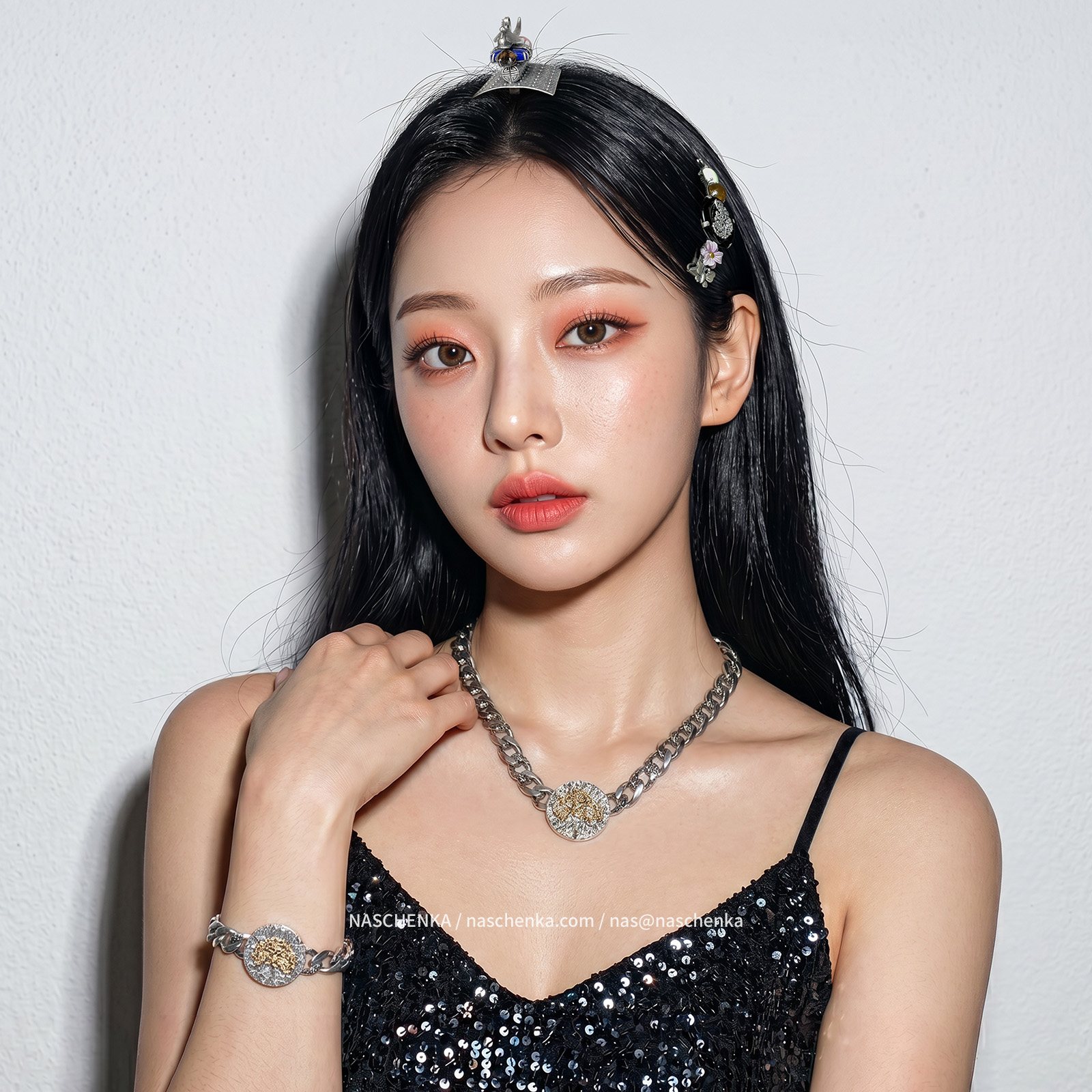
Korean heritage jewelry does not stop at the binyeo and the norigae. The same silver, the same stones and the same motifs make earrings, necklaces, bracelets and rings — jewelry for every day that anyone can see is Korean.
Older than the hairpin
Korea's earliest jewelry masterpieces were not hair ornaments. The earrings of the Silla royal tombs, in gold rings hung with leaf spangles; the necklaces of gold and jade gogok, the comma-shaped jewel of Silla; the bracelets of King Muryeong's queen in Baekje, in silver, signed by their maker. The jewelry of the body came first. Joseon moved ornament into the hair; today it returns to the ear, the neck and the wrist.
What makes it Korean
- Silver, worked by hand. 925 silver melted, cut, hammered, engraved and pierced — finished in white or in gold over silver, as at the Joseon court.
- Korean stones. Jadeite, nephrite, coral and amber, chosen for colour and for meaning.
- Korean motifs. The peony of wealth and honour, the phoenix of the queen, the dragon, the bat of good fortune, the butterfly, plum and bamboo, the knot of the norigae.
- Korean proportion. Restraint, line and balance — the quiet that Korean design is known for.
Earrings
Silver earrings with Korean motifs and stones, with 14K gold posts for comfort.
Necklaces and bracelets
Pendants and chains in silver, with jadeite, coral and amber, and medallions engraved with Korean motifs.
Rings
The jade ring and the paired garakji are the Korean rings. Rings are also the piece visitors to Korea love most — a jewel that carries Korea on the hand.
Brooches
Silver brooches with traditional motifs — worn on a coat, a jacket, or the tie of a hanbok.
Designed by Kim Seong-eun
At NASCHENKA, every piece — binyeo or earring — is designed by Kim Seong-eun. Her measure is simple: whatever the form, the piece must read as Korean, distinctly, even among the jewelry of East Asia.
Shop at naschenka.com English store
References
- Encyclopedia of Korean Culture (한국민족문화대백과사전), Academy of Korean Studies — entries on 비녀, 뒤꽂이, 첩지, 족두리, 화관, 노리개, 가락지, 떨잠, 댕기. encykorea.aks.ac.kr
- National Research Foundation of Korea, Dictionary of Korean Costume (한국복식사전), via Academy of Korean Studies Digital Humanities. dh.aks.ac.kr
- National Palace Museum of Korea — ornaments of the Consort of Imperial Prince Yeong, via Google Arts & Culture. artsandculture.google.com
- Gyeongju National Museum and Gongju National Museum — Silla gold ornaments and the finds from the tomb of King Muryeong.
- Sookmyung Women's University Museum — Joseon women's ornaments and hairstyles.