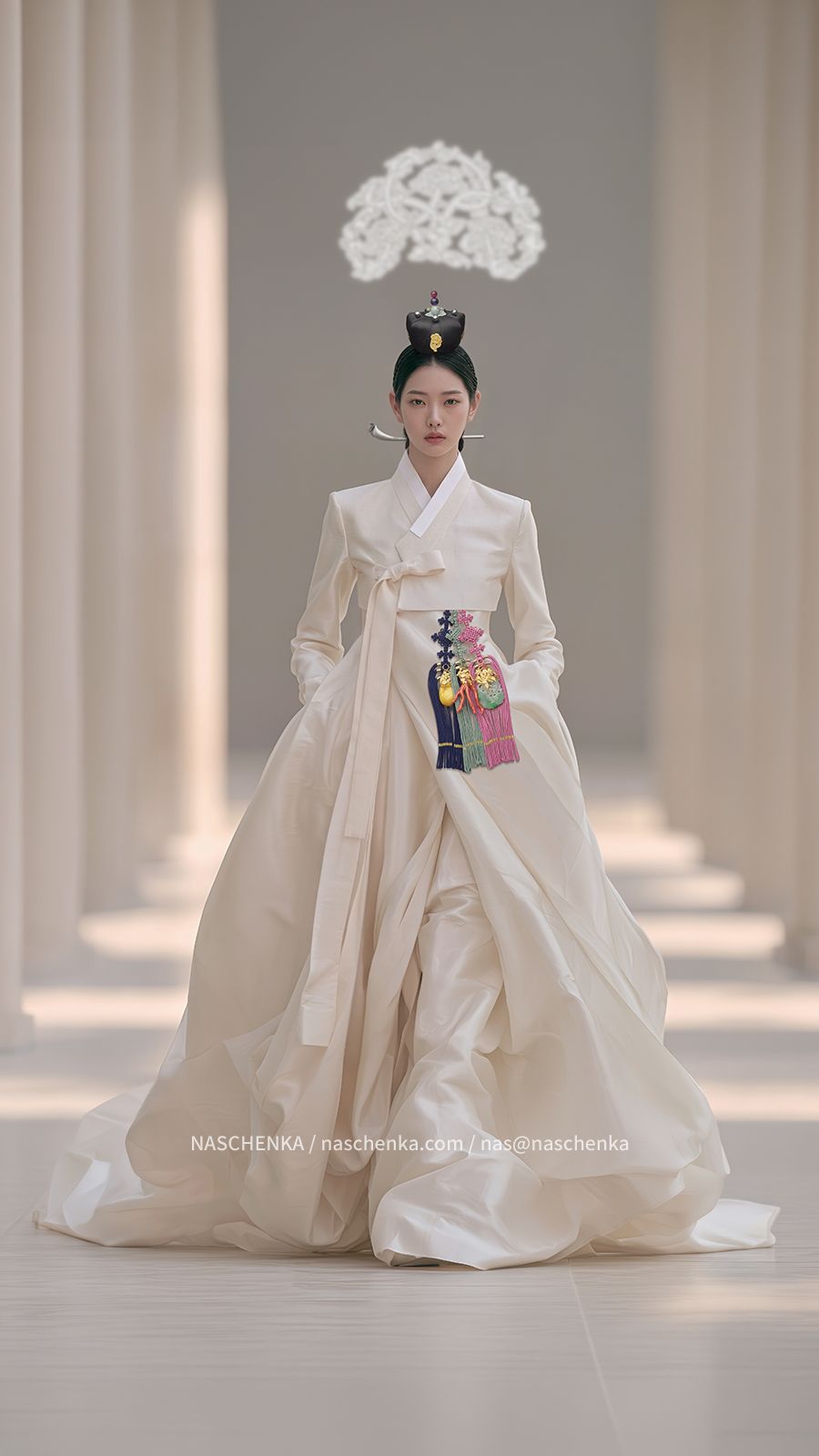
The rule of Korean formal dress is order: each ornament has one place. Keep to it, and even a single piece looks right.
With hanbok
- Hair in a low chignon, held by a binyeo.
- One to three dwikkoji in the chignon.
- For ceremony, a cheopji on the parting and a jokduri on top.
- A norigae on the jacket tie or at the skirt waist.
- Paired garakji on the hand.
At a wedding
The bride wears the jokduri or hwagwan with a binyeo and dwikkoji, and the samjak norigae. Mothers of the couple wear a binyeo and dwikkoji and a single norigae.
Every day
One piece is enough: a binyeo in a low bun, a cheopji on a centre parting, a dwikkoji in a twist, a norigae on a bag or a coat. Silver goes with everything.
References
- Encyclopedia of Korean Culture (한국민족문화대백과사전), Academy of Korean Studies — entries on 비녀, 뒤꽂이, 첩지, 족두리, 화관, 노리개, 가락지, 떨잠, 댕기. encykorea.aks.ac.kr
- National Research Foundation of Korea, Dictionary of Korean Costume (한국복식사전), via Academy of Korean Studies Digital Humanities. dh.aks.ac.kr
- National Palace Museum of Korea — ornaments of the Consort of Imperial Prince Yeong, via Google Arts & Culture. artsandculture.google.com
- Gyeongju National Museum and Gongju National Museum — Silla gold ornaments and the finds from the tomb of King Muryeong.
- Sookmyung Women's University Museum — Joseon women's ornaments and hairstyles.