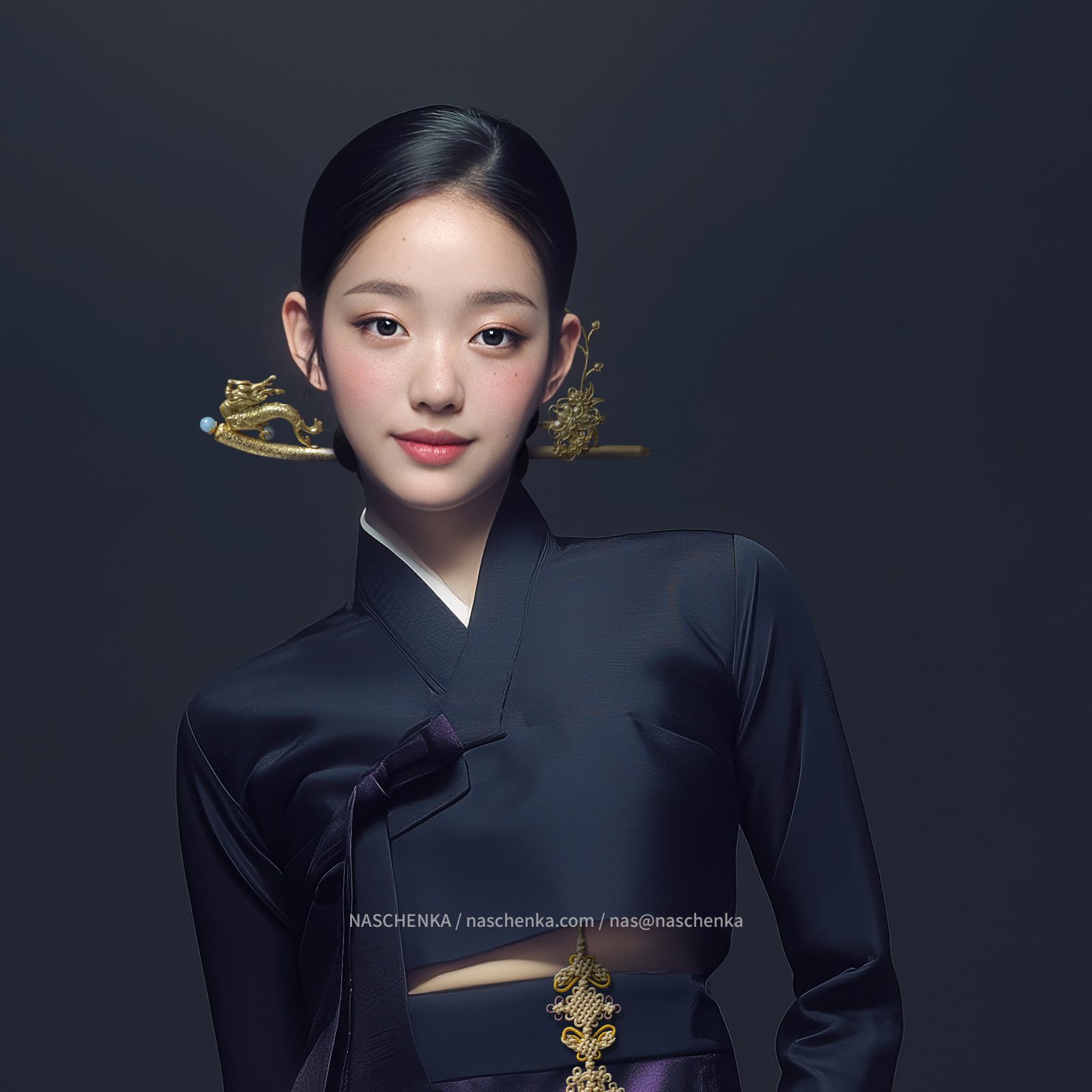
Korean jewelry moved from gold to silver, from display to restraint, and from the whole body to the hair. That arc runs from the royal tombs of Silla to the court of the last empress.
The Three Kingdoms: gold
The royal tombs of Silla in Gyeongju, from the fifth and sixth centuries, held some of the finest gold work of the ancient world: crowns of gold sheet hung with jade gogok, belts with dangling pendants, and earrings of thick and thin rings with leaf-shaped spangles. In Baekje, the tomb of King Muryeong (d. 523) at Gongju yielded the silver bracelets of his queen, inscribed with the name of their maker, Dari.
Silla regulates ornament
In 834 King Heungdeok of Silla issued an edict regulating dress and ornament by rank — materials and decorations reserved for each class, down to the hairpin.
Goryeo
Royal marriages with the Yuan court in the thirteenth and fourteenth centuries brought Mongol court customs to Goryeo, among them the headdress that would become the Korean jokduri.
Joseon: silver and restraint
Neo-Confucian Joseon prized restraint. Jewelry shrank and moved: away from the ears and neck, into the hair and onto the jacket tie. Silver became the material of Korean jewelry, gold was gilded onto silver, and ornament followed rank, marriage and season. In 1572 King Seonjo ordered men to stop piercing their ears. The norigae flourished.
The gache ban and the chignon
By the eighteenth century the great wig, the gache, had become a ruinous luxury. King Yeongjo banned it in 1756, and King Jeongjo issued a stricter code in 1788. Women wore their own hair in a low chignon, the jjok, held by a binyeo, decorated with dwikkoji, with a cheopji on the parting at court and a jokduri or hwagwan for ceremony.
The Korean Empire
From 1897 to 1910 Korea was an empire, and its last royal women — among them the Consort of Imperial Prince Yeong — left ornaments now in the National Palace Museum of Korea: gilt silver binyeo, phoenix ornaments, cheopji and tteoljam.
After the court
The court ended; the jewelry survived in weddings, dance and museum cases, and from the late twentieth century in historical dramas. In the twenty-first century it returned as jewelry worn every day.
References
- Encyclopedia of Korean Culture (한국민족문화대백과사전), Academy of Korean Studies — entries on 비녀, 뒤꽂이, 첩지, 족두리, 화관, 노리개, 가락지, 떨잠, 댕기. encykorea.aks.ac.kr
- National Research Foundation of Korea, Dictionary of Korean Costume (한국복식사전), via Academy of Korean Studies Digital Humanities. dh.aks.ac.kr
- National Palace Museum of Korea — ornaments of the Consort of Imperial Prince Yeong, via Google Arts & Culture. artsandculture.google.com
- Gyeongju National Museum and Gongju National Museum — Silla gold ornaments and the finds from the tomb of King Muryeong.
- Sookmyung Women's University Museum — Joseon women's ornaments and hairstyles.