Ten ornaments make up the core of Korean heritage jewelry. Each has its own place on the body, its own job, and its own specialist guide.
Binyeo 비녀
The hairpin. A long pin passed through the low chignon to hold it. Its head shows the motif — dragon, phoenix, plum, bamboo — and once showed rank. Read more at binyeo.com.
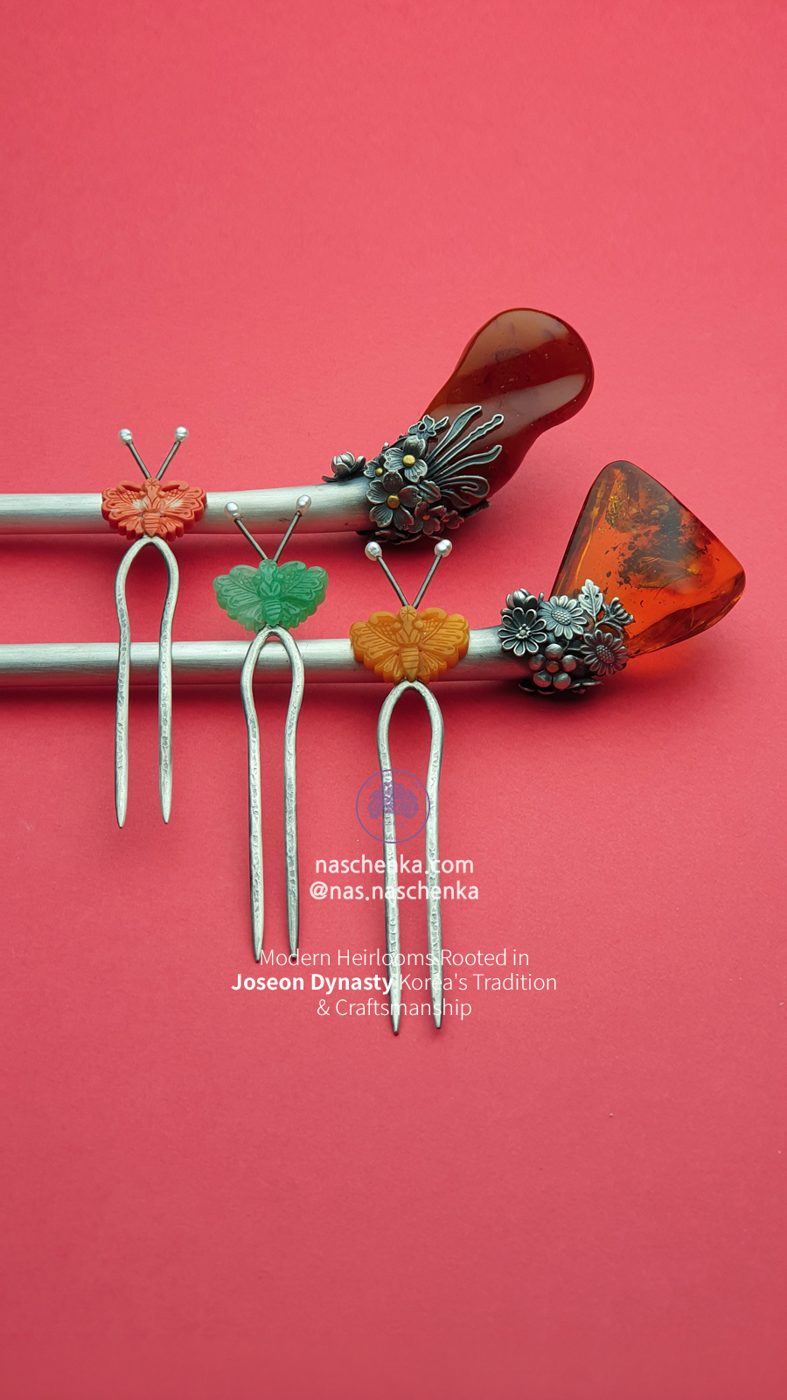
Dwikkoji 뒤꽂이
The ornament behind the chignon. Tucked into the finished chignon from above. Decorative, often worn in pairs or threes; some forms are also an ear pick or a parting tool. Read more at dwikkoji.com.
Cheopji 첩지
The parting ornament. Worn flat on the centre parting by women of the court. Its dragon, phoenix or frog head showed rank; it also steadied the crown. Read more at cheopji.com.
Jokduri 족두리
The bridal coronet. A small six-sided crown set on top of the head for weddings and formal dress. Read more at jokduri.com.
Hwagwan 화관
The flower crown. A more open, decorated crown worn with ceremonial dress and at weddings. Read more at jokduri.com.
Tteoljam 떨잠
The trembling pin. Ornaments set on fine springs so that they quiver as the wearer moves; worn on the great court hairstyles. Read more at dwikkoji.com.
Daenggi 댕기
The hair ribbon. A ribbon at the end of a braid or tied into formal hair; some carry metal ornaments. Read more at dwikkoji.com.
Norigae 노리개
The pendant. Hung from the jacket tie or the skirt waist: a top fitting, a main ornament, a knot and a tassel. The three-part samjak is the grandest. Read more at norigae.co.kr.
Garakji 가락지
The paired ring. Two identical rings worn together, the ring of married women. A single ring is a banji.
Sangtu-gwan and donggot 상투관 · 동곳
Men's ornaments. The small crown over a man's topknot, and the pin that held the topknot.
References
- Encyclopedia of Korean Culture (한국민족문화대백과사전), Academy of Korean Studies — entries on 비녀, 뒤꽂이, 첩지, 족두리, 화관, 노리개, 가락지, 떨잠, 댕기. encykorea.aks.ac.kr
- National Research Foundation of Korea, Dictionary of Korean Costume (한국복식사전), via Academy of Korean Studies Digital Humanities. dh.aks.ac.kr
- National Palace Museum of Korea — ornaments of the Consort of Imperial Prince Yeong, via Google Arts & Culture. artsandculture.google.com
- Gyeongju National Museum and Gongju National Museum — Silla gold ornaments and the finds from the tomb of King Muryeong.
- Sookmyung Women's University Museum — Joseon women's ornaments and hairstyles.