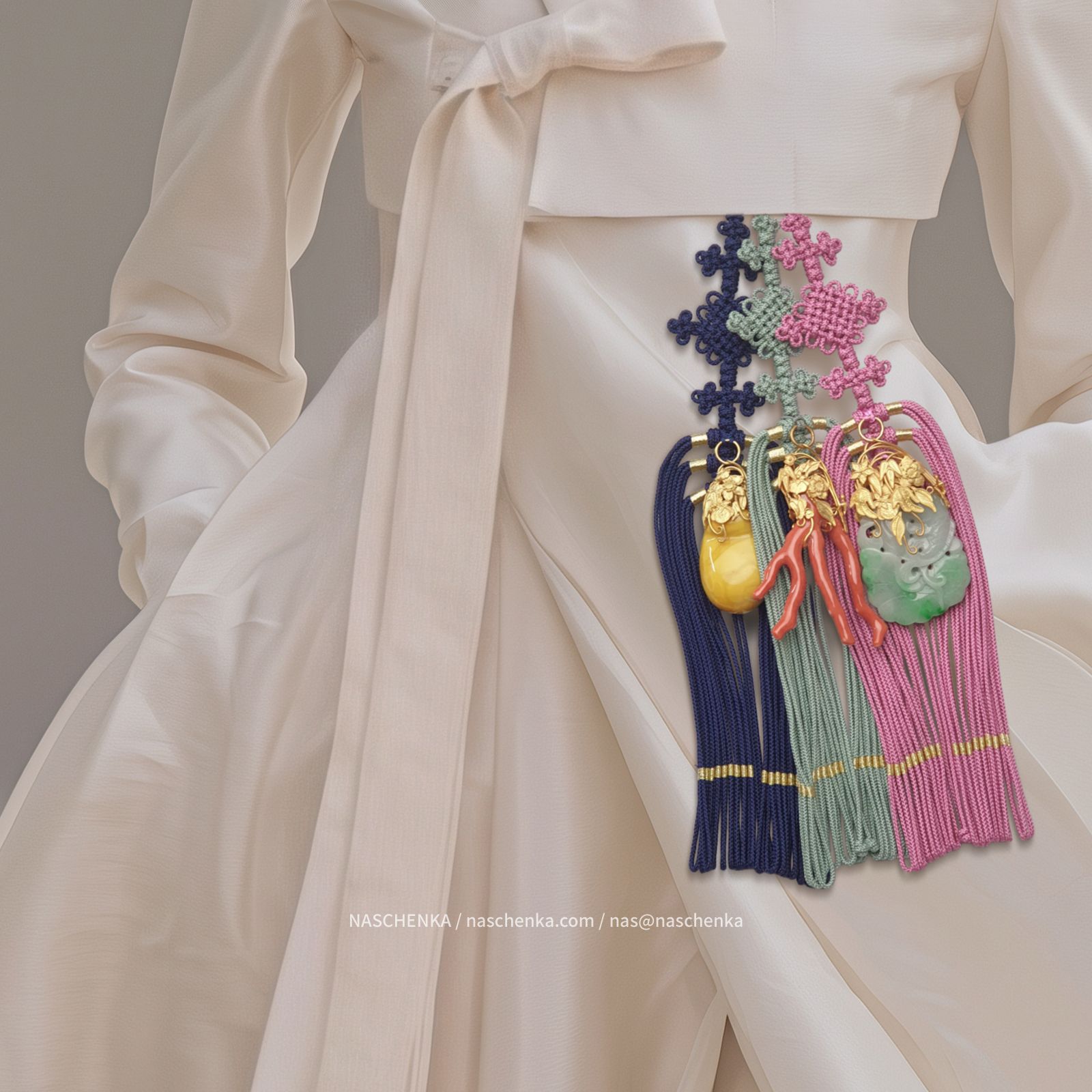
Korean heritage jewelry chose its materials for meaning as much as beauty. Read the stones and you read the wish.
| Material | Korean | Traditional meaning |
|---|---|---|
| Silver | 은 | The body of Joseon jewelry; purity, and protection |
| Gilt silver | 도금 | Royal gold, worn over silver |
| Jadeite | 비취 | Peace and fidelity |
| Nephrite | 옥 · 백옥 | Virtue and constancy |
| Coral | 산호 | Life, vitality, protection from misfortune |
| Amber | 호박 | Fortune and long life |
| Pearl | 진주 | Purity; the jewel of the sea |
| Enamel | 칠보 | Colour on silver; the spring rings of the court |
| Silk | 명주 | The knots and tassels of the norigae |
Silver
Silver is the material of Joseon jewelry. Today the standard is 925 sterling silver: silver worked by hand — melted, cut, hammered, engraved and pierced. Gold colour, where it appears, is gilding on silver, as it was at court.
Stones
Jadeite is often treated to improve its colour; an honest maker says so. Korean baekok, white jade, is nephrite — at NASCHENKA, natural nephrite from Chuncheon. Coral and amber are soft and organic and need gentle care.
Silk
A norigae's knot and tassel are made of silk thread, braided and tied by hand. Ready-made norigae in polyester or nylon are assembled from factory parts. The difference is in the lustre, the hand, and how the tassel moves.
References
- Encyclopedia of Korean Culture (한국민족문화대백과사전), Academy of Korean Studies — entries on 비녀, 뒤꽂이, 첩지, 족두리, 화관, 노리개, 가락지, 떨잠, 댕기. encykorea.aks.ac.kr
- National Research Foundation of Korea, Dictionary of Korean Costume (한국복식사전), via Academy of Korean Studies Digital Humanities. dh.aks.ac.kr
- National Palace Museum of Korea — ornaments of the Consort of Imperial Prince Yeong, via Google Arts & Culture. artsandculture.google.com
- Gyeongju National Museum and Gongju National Museum — Silla gold ornaments and the finds from the tomb of King Muryeong.
- Sookmyung Women's University Museum — Joseon women's ornaments and hairstyles.